
The following are systems & guidelines made to direct fair roleplay. While they are not in the Rules section, they can be enforced by the Moderation team.
Table of Contents
- Part A – Design Guidelines
- Part B – Trap Guidelines
- Part C – Guard Guidelines
- Part D – Captive Guidelines
- Part C – Credits
Players must always explicitly consent to Capture RP that is over 48 OOC hours. Players may be captured without consent and be held for under 48 OOC hours, but cannot be recaptured for 2 OOC weeks after that time is up. This includes “cross-teaming” by paying off or recruiting others to capture the player again. These players do not have to consent to any injuries or deaths at any point in short captures.
A dungeon, prison, or capture structure is a location with the intent to hold players as captives for a period of time. When creating these structures, it is important to remember the captor is responsible for the roleplay experience the captives have. If a structure lore locks a captive, especially for a long period of time, it is very easy to fall into miscommunications on what the roleplay will consist of.
When holding players captive, the captor is taking on the role of Dungeon Master for the captives. It is important to offer an enjoyable roleplay experience for everyone involved- the design of the structure is not made to “win” or “beat” those captured, it’s to have fun!
It is important to communicate with the captives on what kind of roleplay they are looking for. Do they want a prison escape event? A social roleplay between captor and captives? A puzzle to solve within the structure? Laying out expectations and what themes and topics everyone is comfortable with can help you prioritize what is most fun for others.
Design Redlines
- A dungeon, prison, or capture structure cannot keep a captive in a location with no roleplay environment.
- For example, a player cannot be kept in a small, unfurnished box.
- Roleplay opportunities between captivates should exist. For example, creating a small apartment environment in which captives are trapped within. (Give your captives an enrichment enclosure, like hamsters!)
- A dungeon, prison, or capture structure should consist of, at least:
- 1 prison room, where the captives are held.
- 1 primary path out of the location, this connects the primary room & prison room to the first exit.
- At least 1 secondary path out of the location, this path can be more inconspicuous and should lead to the second exit.
- At least 1 trap room that connects to the prison room, this leads to the exit!
- At least 2 exits. These must be marked by separate doors or gates and cannot be within 16 blocks of each other nor within line of sight.
- Once the captive is within their cell, all traps and rooms cannot be altered.
- Doors and gates, and windows are not considered traps and always separate rooms.
- Neutral rooms are rooms with no traps within them. These rooms do not count as escape rooms and have no effect on rolls.
- This means if a guard is rolling to notice a captive escaping, the neutral room does not count as a room over from the captive.
- The maximum number of escape rooms is +3 that of the number of current captives. (Ex. 2 captives = 5 escape rooms.)
- After beating the last escape room, the captives should find a “Master Key” that bypasses the rest of the traps, leading the captive straight through the door. However, guards can follow captives throughout the rooms.
- The rest of the door and gate DC’s are bypassed except for the last one blocking the exit.
Bare Minimum Design
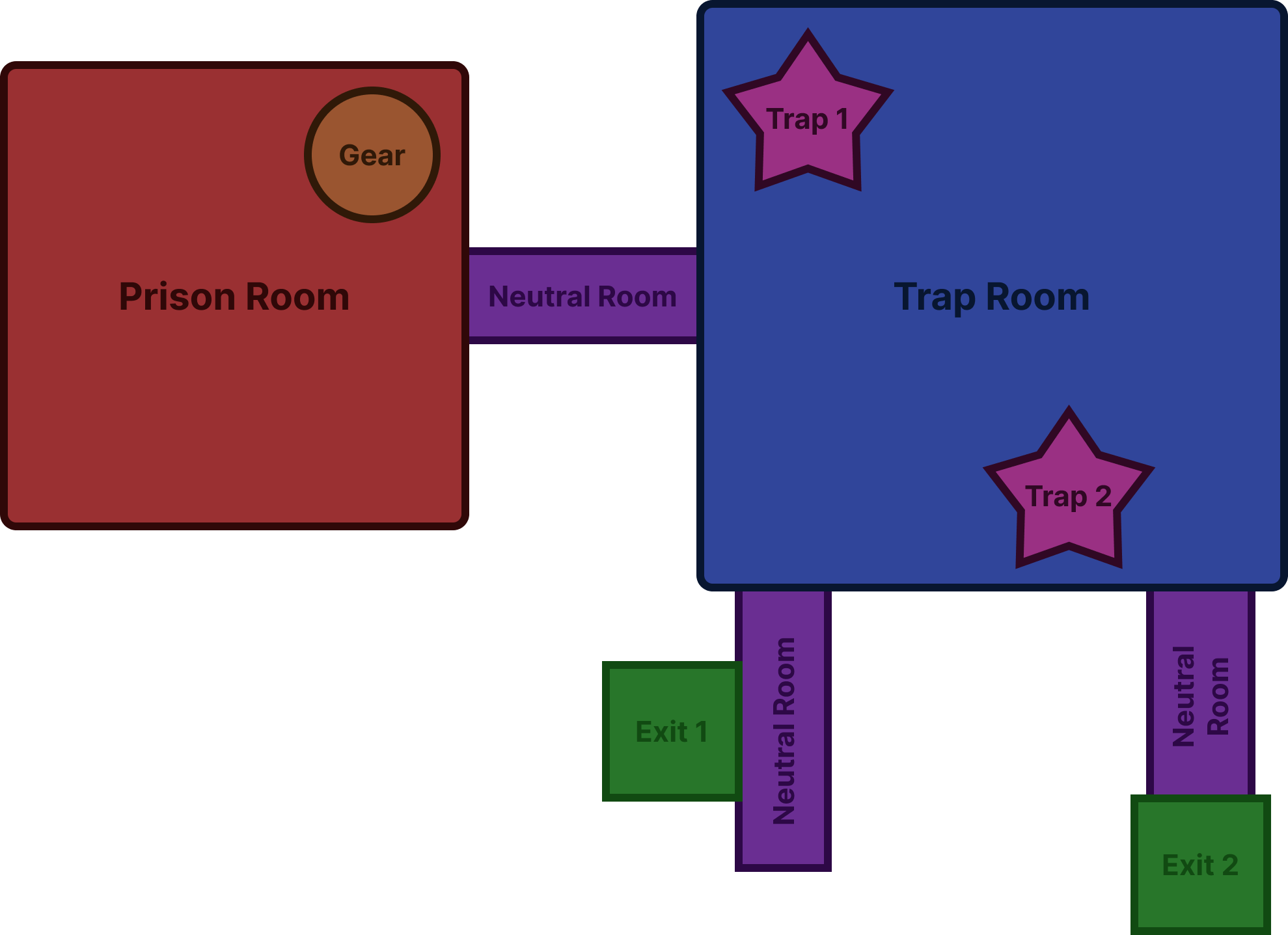
Dungeons, prisons, and capture structures should have rooms laid out. Within a room, regardless of its size, there can be up to 2 traps or obstacles at a time. A trap or obstacle can only be used once in the structure. Any and all escape attempts must be made with at least the captor or one guard online.
A guard counts as a trap or obstacle. There can only be +1 guards to captives set as obstacles within a structure. (Ex. 2 captives equals up to 3 guards as traps.) Guards cannot call for backup, meaning nobody else but the captives and present guards can engage with the encounter at all, including any and all roleplay and CRP fights.
“Spawncamping” (captors or the guard staying by the dungeon, prison, or capture structure) outside or near the exit, even when not in the encounter, counts as exploiting a loophole and can be punished by moderation.
The guidelines provided for Roleplay and Mechanical Traps apply globally.
Identifying Traps
Traps can be identified with a DC13 INT saving throw. Roll once to identify only one of the traps of the captor’s choice. There has to be a physical way out of any trap, meaning you cannot drop people in a 2x1 hole or set the entire floor on fire forever!
Roleplay Traps (CRP)
If a trap is triggered, the escapee must roll a DC15 STR/DEX saving throw. Upon success, they avoid the trap. Traps can be triggered by anyone in the structure, even guards and captors. Traps can have a variety of purposes:
- Pure Damage
- Damage cap is 2d4 Slashing, Piercing, or Bludgeoning damage. This damage is applied during future combat encounters until the end of the entire roleplay/escape encounter.
- You still have to encounter the other trap in the room.
- Example Trap: A long-serrated bear trap that sinks into your legs, causing instant damage of 2d4 piercing into your body.
- Movement
- When moving the escapee around, it can be across the room or into another room. This alternative room must be able to be escaped from and lead back into the previous or next escape room.
- This alternative room, though, does not count as an escape room. There can only be 2 alternative rooms in a structure maximum.
- If moved to another room, it can only have 1 other trap inside it rather than 2.
- Example Trap: A pressure plate is stepped on, and you are dropped into a room with a soulsand floor- At the end of the room, there is an alarm trap represented by a trip wire. Past that is a step that leads to a door for you to escape from.
- Alarm
- An alarm trap alerts any guards within an adjoined room, meaning connected with a door or wall.
- This can be commonly represented with a tripwire or sign.
- Example Trap: An array of brass bells that loudly ring when touched- This alerts Johnny in the next room that you have escaped, but where is Johnny? You must roll a DC14 INT saving throw to hear what direction the bells are sending noise to.
- Guard
- Guards as an obstacle allow you to have players positioned in this room.
- Must follow all guard guidelines!
- Example Trap: I have Johnny sitting by the door to the next room. Johnny is mad. Johnny is willing to die for minimum wage.
- Status Effect
- A status effect from the CRP document is afflicted upon the first 2 rounds of the next combat encounter in this roleplay.
- Example Trap: A dust that shoots out when a person looks into a peep hole without paying attention, causing a noxious fume to proliferate into the air, causing all creatures within an area to suffer the Poisoned condition for 1d4 turns.
- A status effect from the CRP document is afflicted upon the first 2 rounds of the next combat encounter in this roleplay.
- Self-Destruct
- Triggering this trap automatically applies 5 + 1d8 Bludgeoning damage. This damage is applied during future combat encounters until the end of the entire roleplay/escape encounter.
- This trap can only be used a maximum of 3 times per structure.
- Escapees automatically get to avoid the other trap in the room.
- Example Trap: A giant boulder drops from the ceiling and crushes you, dealing 5 + 1d8 Bludgeoning damage. After crushing your skull, it rolls off and destroys the other trap in the room, it could even steamroll Johnny.
Mechanical Traps (PVP)
In the mechanical sense, a trap is defined as: A structure created with the intent to impede, damage, or deter an opposing party from something. These traps are simple and do not need moderation approval. Any traps that exceed or loophole these guidelines must be approved by moderation.
These traps also count towards the 2 traps per room rule. The pure damage trap or movement trap count as the same trap as their roleplay counterpart (Ex. A dripstone trap can deal 5 hearts to a captive as well as 2d4 damage in CRP upon triggering.)
- Pure Damage (Mechanical)
- Fall traps (dripstone, high drop) cannot deal more than 10 HP (5 hearts) to a player wearing T2 armor or above with no status effects or enchants.
- Any trap that does not fall under these categories (arrows, fire tick) that does damage of any sort cannot do damage above three hearts to a player wearing T2 armor (Titanium, Tungsten Carbide) or above with no status effects or enchants.
- There can be no instant-death traps.
- Traps cannot use lava or water in any aspect. The room can have it as decoration but cannot hurt or hinder the captive.
- Fire traps must extinguish after 3 seconds and cannot be spammed.
- Movement (Mechanical)
- Movement traps count as redstone or block structures that impede a player’s ability to progress throughout the room. (Ex. slabs that open up the floor, a layer of cobwebs.)
- Soulsand is not considered a movement trap and can be implemented freely.
- Different leveled blocks or doors cannot be used to alter a player's active state.
- Example Trap: A trap that forces a player to go prone.
- Movement traps count as redstone or block structures that impede a player’s ability to progress throughout the room. (Ex. slabs that open up the floor, a layer of cobwebs.)
- A trap cannot take your ability to hit or move properly completely away.
- Traps cannot require you to sit on an object to escape.
- Powdered snow cannot be used in traps or rooms at all.
- Cobwebs cannot be used in traps. Only for minor decoration.
- Traps cannot require you to sit on an object to escape.
- Mechanical Constraints
- A mechanical trap cannot constitute an area that is larger than 4x4.
- Redstone openings still cannot be larger than 3x3.
- The three block hit range is not accounted for in the 4x4 constraint.
- Every trap must be escapable, with a clear and accessible exit.
- All traps must be escapable within 10 seconds.
- The exit must be accessible to anyone, even if they do not have region permissions.
- A mechanical trap cannot constitute an area that is larger than 4x4.
- There can be no full room traps.
- Example Trap: An entire room 4x4 that has pistons drop down and fill the room with sand.
- Redstone doors do not count as traps, but can always be broken or lockpicked regardless of how they are made.
- Doors that require “keys” cannot be keycards and must literally be keys.
- Keys are items with special names that when dropped in hoppers open doors.
- A gatehouse consists of two gates within 16 blocks or less of each other, designated to trap players within them.
- These are considered escape rooms, but can only be rigged with 2 non-damaging traps.
- Only alarm traps and movement traps are non-damaging.
- Movement traps cannot open up the floor in gatehouse escape rooms.
- Openings between walls do not count as traps.
Guards are a difficult aspect to effectively incorporate into dungeons, prisons, and capture structures. One of the biggest mistakes made when utilizing guards is instant-combat engagement. Please remember that, in accordance with moderation rules, adequate roleplay must occur before combat can be initiated. In addition, permanent injury and death cannot be inflicted on another player without their consent.
Another common mistake is unreasonably balanced combat encounters. Realistically, two unarmed captives will not stand any chance against five T2 geared guards. Please adhere to the following guidelines to balance guard encounters. These guidelines allow guards to be slightly stronger than captives, while giving them a reasonable chance in combat!
Guard Redlines
- There must be some way to acquire gear comparable to what the guards are using in the dungeon, prison, or capture structure.
- Captive gear cannot be below 2 tiers of quality below what the guards are using. 1 piece of discoverable captive gear should be at least 1 tier of quality below what the guards are using. This applies per captive.
- For example, if the guards have full Tungsten Carbide gear. Each captive must have access to Bronze gear, and an additional single piece of Carbon Steel or Stainless Steel gear.
- If guards are using T1 or T0 gear, captives must have access to Boiled Leather, Silk, & Bronze weaponry.
- This gear must be attainable before engaging with the guards!
- This gear also cannot harm the captive. (Ex. Bronze armor cannot be used for vampiric characters.)
- If guards have potions and scrolls in their kit, the same potions and scrolls should be discoverable and attainable by the captives before engaging with the guards.
- If guards have food, half the same food should be discoverable and attainable by the captives before engaging with the guards
- Guards must roleplay with captives before engaging in combat. Adequate reason for engaging in combat is required!
- A couple emotes of ordering them to return to their cell is reason enough- but a conversation must be had.
- When engaging in combat against captives, a maximum number of guards equal to the number of captives in the combat encounter may participate in the combat encounter.
- For example, if a combat encounter begins with 2 captives, then no more than 2 guards may join the combat encounter.
- Guards always get defenders' choice by default.
A captive must have at least 2 escape attempt interactions per 1 OOC week from their captors. Lack of roleplay counts as FailRP and the captive is allowed to open a ticket to be freed by moderation if this requirement is not met.
This interaction can be attempting to lockpick, solving a puzzle, attacking the guard, etc. The captive gets to decide the attempt type! Keep in mind, not all interactions with the captives must be escape attempts, but you still must meet the minimum requirement.
There is a release timer on all captives from 1 OOC month exactly from the time they were captured. This does not reset if the captive fails to escape. If they fail to escape after this time is up, the captive must be released.
The captive cannot be sought by the same capturers or guards for 2 OOC hours upon escaping. The captive also cannot return to the same premises or interact with the ongoing scene for 2 OOC hours upon escaping.
Before release, within the hour, the captive is subject to 1 permanent injury without consent that does not include loss of limbs or loss of senses upon escaping. (Ex. Burns, scars, disfiguring, primordial water acid.) If the captor decides, they may choose to soft kill them without consent instead. The captor cannot do both, though, they must pick whether to soft kill or permanently injure. If you are ever unsure an injury isn’t allowed, you may ask moderation!
Anything and everything can be negated or altered if explicitly agreed upon OOCly, all involved captives, guards, and captors must consent to this. Always get proof of consent in text form.
Finally, captives will keep all their stuff unless emoted otherwise. This emote does not have to be specific, if a guard emotes taking all things off your persons, you bring nothing into the structure.
The guidelines provided for Lockpicking and Material DC’s apply globally.
Lockpicking DC’s
You can attempt to lockpick or break the lock of an object two attempts per roleplay encounter, but the DC increases by 3 for each failure. Lockpicking must be done in the presence of the captor or guards OOCLY.
Upon success, it leaves no traces of the captive entering or leaving the room. If lockpicked, present guards must roll a DC14 INT to realize someone has left, within 1 escape room of the previous room. They can only roll once per lockpicked object. However, even if they realize the captive has left, this does not mean they know where the captive has gone.
The lockpick item provides a +2 bonus to lockpicking rolls. If the roll is failed using this item, it breaks and cannot be used again. Consume or trash the lockpick item if it breaks!
| Objects | DC |
|---|---|
| Miscellaneous | 10 DEX |
| Windows | 11 DEX |
| Doors | 12 DEX |
| Gates | 14 DEX |
Material DC’s
You can attempt to overwhelm, damage or break objects made of certain materials two attempts per roleplay encounter, but the DC increases by 3 for each failure. Altering materials must be done in the presence of the captor or guards OOCLY.
Upon success, all guards within the structure will be alerted that the captive has left the cell, regardless of where they are. However, even if they realize the captive has left, this does not mean they know where the captive has gone.
The minimum DC increases by +1 if the material is registered as a gate or redstone contraption in block form.
(Ex. A wooden gate has a DC7 STR, or a Tungsten Carbide block redstone door has a DC13 STR.)
| Tier | Materials | DC |
|---|---|---|
| Undefined | Miscellaneous | 7 STR |
| Wood | Planks, Wooden Items | 8 STR |
| Metal | Iron, Gold, Copper, Diamonds | 9 STR |
| Tier 0 | Bronze | 10 STR |
| Tier 1 | Carbon Steel, Stainless Steel | 11 STR |
| Tier 2 | Tungsten Carbide, Titanium Alloy, Mithril | 12 STR |
| Tier 3 | Adamantine - Inflicts 1d2 Infernal Damage upon every failure. | 12 STR |
This document was originally published by Ame and Lux with the help of New World, Ghost, Cranes, Dark, and Thomas.
This ruleset was reviewed by moderation and approved by Anna and Miri on April 6th, 2026.